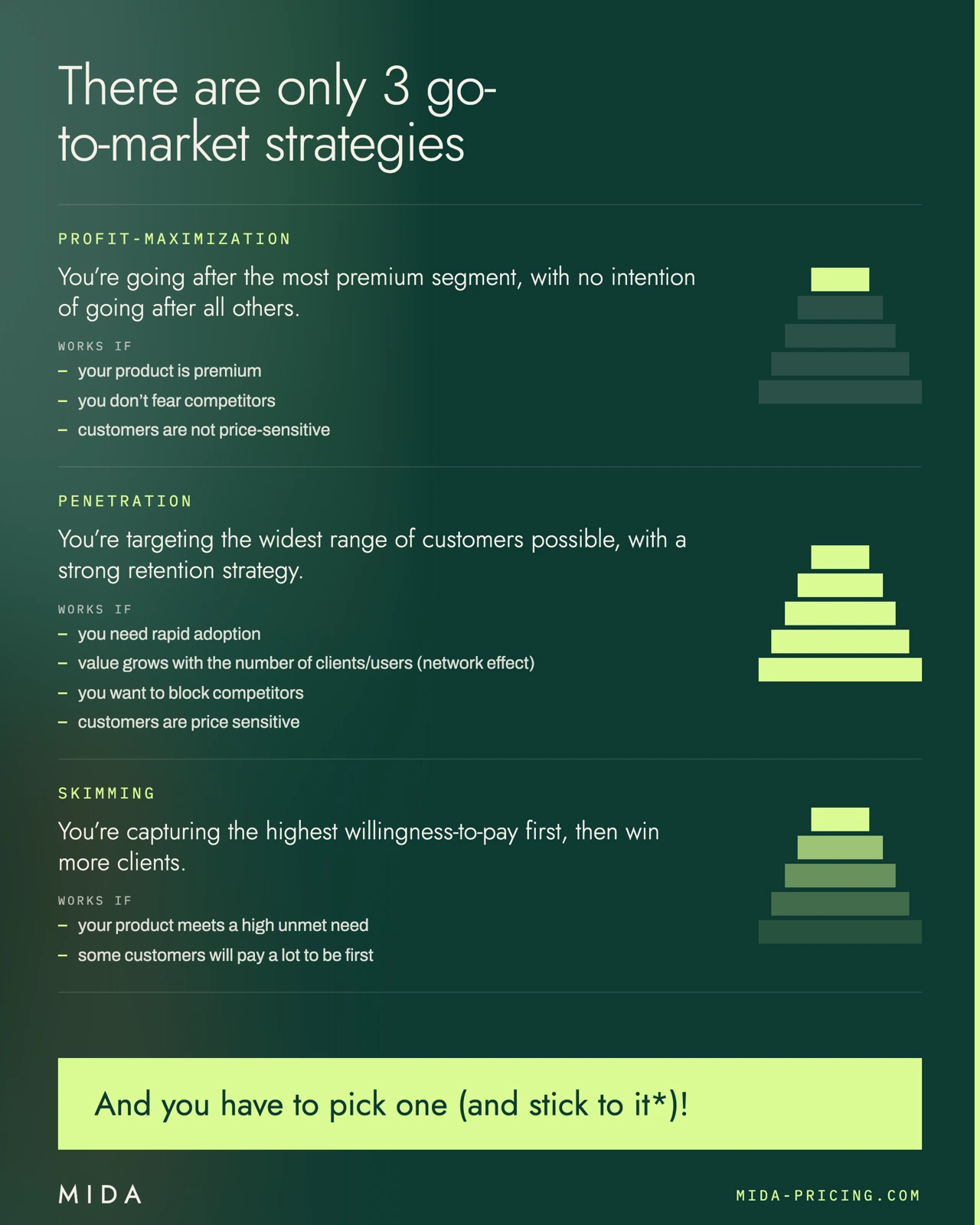
There are only three pricing strategies, and you have to choose one, because their trade-offs are incompatible.
The Roman philosopher Seneca wrote: “If you do not know which port you are sailing to, no wind is favorable.”
Well, in pricing, that’s super true.
Pricing in tech is complex. It’s a puzzle, and companies can get it wrong for dozens of reasons. But one is almost always at the root of all the others: the lack of a pricing strategy.
When founders, investors, Sales and Product are not aligned on one pricing strategy, they make inconsistent decisions that slow growth down.
There are only three pricing strategies, and you have to choose one, because their trade-offs are incompatible.
Let's have a closer look at how each strategy comes with trade-offs you can’t mix:
1. Penetration: competitive pricing
Implications:
- pricing must be accessible
- margins come later
- product must be easy to onboard
- product must lock customers in (this is the part most startups tend to disregard)
- roadmap focuses on features driving acquisition and stickiness
2. Skimming: high price at launch, decrease later
Implications:
- product must deliver strong perceived value early (resolves a high unmet need that is already identified by customers, you don’t have to pitch it)
- a "lighter" version of the product comes later
- volume comes later
3. Profit maximization: high price, premium positioning
Implications:
- precise client targeting
- precise feature roadmap designed to satisfy the needs of that one customer segment with the highest willingness-to-pay